
The sharp rally in the broader markets has propelled India's market capitalisation (m-cap) to a new high. The combined m-cap of all BSE-listed firms rose to Rs 291.9 trillion in intraday trade on Thursday before settling lower at Rs 290.9 trillion. The previous record was on December 14, 2022, at Rs 291.3 trillion.


'Historically, the markets tend to perform well during election years as governments aim to increase spending and call attention to growth.'

The stock of the country's largest passenger vehicle maker, Maruti Suzuki India (MSIL), has been hitting successive all-time highs over the past three trading sessions. The rally in the scrip has helped it notch over a 21 per cent gain since the start of February, outperforming the National Stock Exchange Nifty Auto Index. The gains for the leader of small passenger cars have been more recent, as the company still trails the Nifty Auto over one- and two-year periods.
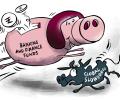
Even as banks and finance companies are reporting record-high earnings, their weighting in the benchmark National Stock Exchange Nifty50 Index has seen a downward trajectory. Investors expect a stronger performance from other sectors in the new year. Currently, banking, financial services and insurance (BFSI) companies collectively hold a weighting of 34.5 per cent, down from 36.7 per cent at the end of December 2022 and a record high of 40.6 per cent at the end of December 2019. This represents the sector's lowest weighting in the index since December 2021 when it stood at 33.7 per cent.
The 50-share National Stock Exchange index Nifty shot up by 44.80 at 4,568.55, after moving between 4,578.75 and 4,504.85 points during the day. The upsurge was maintained by Maruti Suzuki, which raced to an all-time high a day after the leading carmaker reported a 25 per cent jump in quarterly profit on higher sales and lower raw material costs.
The 50-share National Stock Exchange index Nifty also shuttled between 4,524.00 and 4,436.60, before winding up at 4,469.10, showing a net loss of 33.15 points. The information technology sector, which led the upsurge in Tuesday's trading, suffered the most, losing 1.74 per cent to 3,694.03, as segment major Infosys and Tata Consultancy dropped on profit booking.

The 30-share Sensex lost 12 points to end at 29,559 and the 50-share Nifty climbed 4 points to close at 8,914.
The NSE Nifty sank by 159 points at 3491 points.

'While Indian markets are indeed not inexpensive, the valuations of largecap stocks are still a considerable distance from being overstretched.'
The Bombay Stock Exchange benchmark Sensex today fell by over 150 points ahead of the release of inflation data amid weak international trend as oil prices firmed up globally.
Both equity benchmarks--the Sensex of the Bombay Stock Exchange and the Nifty of the National Stock Exchange-- have gained 14 per cent and 12 per cent, respectively, as the USDX rose by a quick 7.83 per cent in over a month. It touched a high of 77.50 on August 26.

Stocks of public sector companies, especially the oil refining and marketing companies (OMCs) - Bharat Petroleum Corporation Limited (BPCL), Hindustan Petroleum Corporation Limited (HPCL) and Indian Oil Corporation Limited (IOC) - logged gains on Tuesday in a weak market. While the Nifty lost nearly 1 per cent in trade on Tuesday, the Nifty CPSE index - a gauge of performance of central public sector enterprises on the National Stock Exchange (NSE) - gained over 3 per cent in intra-day trade. The rally in PSU stocks comes on the back of the BPCL chairman, Arun Kumar Singh suggesting in the company's annual general meeting (AGM) on Monday that the government intends to complete the divestment process in the OMC by March 2022.
A day before the Reserve Bank's quarterly review tomorrow, the Bombay Stock Exchange benchmark Sensex today closed higher by a marginal 74 points even as brokers and fund operators maintained a low profile.

Reminiscent of the past two years, the market has made positive strides ahead of the Union Budget 2023-24 (FY24). The benchmark National Stock Exchange Nifty has gained 1.8 per cent in the last month. Typically, markets tend to gain ahead of the Budget as investors build in optimism.

From the Sensex pack, Tata Consultancy Services and Infosys fell over 2 per cent each. Hindustan Unilever, Bharti Airtel, Sun Pharma, Power Grid, Bajaj Finserv, HCL Tech, Mahindra & Mahindra, and Tech Mahindra were also among the laggards. Among the gainers, Zomato jumped nearly 5 per cent. Larsen & Toubro, Axis Bank, ICICI Bank, IndusInd Bank and Kotak Mahindra Bank were also among the gainers.

'We emphasise the importance of not basing investment decisions solely on electoral outcomes.' 'Instead, focusing on investing in high-quality businesses capable of prospering regardless of the political landscape is paramount.'

Among major Sensex shares, PowerGrid fell the most by 2.76 per cent. IndusInd Bank dropped 2.34 per cent, HUL by 2.23 per cent and NTPC by 2.04 per cent. ICICI Bank, HDFC Bank, HDFC, ITC, Infosys, L&T, Bajaj Finance, Kotak Bank, HCL Tech and Tech Mahindra were among the losers. On the other hand, Tata Motors rose the most by 2.94 per cent, followed by Titan which gained 1.26 per cent. Mahindra & Mahindra, SBI and TCS were also among gainers.

Riding the wave of the equity market, the mutual fund (MF) industry experienced double-digit growth in Samvat 2079, concluding the Hindu calendar year close to the Rs 50 trillion assets under management milestone. After a subdued 6 per cent growth in Samvat 2078, the industry's assets surged over 18 per cent last year to Rs 46.7 trillion. Industry players anticipate that Samvat 2080 will also be a fruitful year for the asset management industry, given the strong inflows from retail investors, particularly through the systematic investment plan route.

All Sensex firms, except Power Grid, ended in the positive territory. Titan, Bajaj Finance, State Bank of India, Larsen & Toubro, Axis Bank, Bajaj Finserv, Asian Paints and Zomato were the biggest gainers.

The investors had pumped in a net sum of Rs 2,965.66 crore on February 11, the second-highest single-day inflow so far this month.

Only 10 per cent of stocks account for 93 per cent of investments.

Indices across Indian equity markets have edged towards new record highs before undergoing a small correction in the past few sessions. The National Stock Exchange Nifty has gained 20 per cent in the past year; mid-caps (up 33 per cent), small-caps (up 31 per cent), and micro-caps (up 44 per cent) have done better. Several factors have precipitated this rally.

For retail investors who are into direct stocks, buying one when it enters the index can be a good strategy.

The proposal to merge the Gujarat International Finance Tec-City (GIFT City) units of the National Stock Exchange (NSE) and BSE has reached an advanced stage, and both bourses could file an application before the National Company Law Tribunal as early as this month, according to a top regulatory official. Sources indicate that the merger proposal has received approval from their respective boards. Both the NSE and BSE are arch rivals when it comes to onshore trading.

India VIX has been mirroring the CBOE Volatility Index.
The frequent flash crashes - sharp falls in stocks or indices within minutes - have the Securities and Exchange Board of India (Sebi) worried.

The overseas market has developed into a significant competitor for India's two biggest markets -- rupee and stocks, the pre-Budget Economic Survey 2013-14 said, adding that ten years ago, the global market was practically absent in both these fields.

Among Sensex stocks, Tata Motors rose the most by 2.79 per cent. NTPC, Reliance Industries, Infosys, TCS, HDFC twins, Tata Motors, ITC, Power Grid and Bajaj Finserv were among the major gainers. Tata Steel fell the most by 1.22 per cent. L&T, Sun Pharmaceuticals, IndusInd Bank and Ultratech Cement were among the losers.
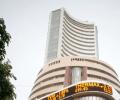
In a range-bound trading, the BSE benchmark Sensex ended a shade higher by 1.57 points in the special 90-minute trading today as funds refrained from making any major commitments in the absence of global cues.

Two equity funds at the opposite ends of the risk matrix - small-cap and arbitrage - bucked the 'low inflow' trend in May this calendar year 2023 (CY23) to receive the highest net inflows in recent years. The Rs 3,280-crore net inflows into small-cap schemes in May was the highest for the category since the mutual fund (MF) industry started releasing fund-wise inflow data in April 2019. Arbitrage schemes raked in a net Rs 6,640 crore - the highest since July 2021.
Emerging business theme-based funds basically invest into mid and small-cap stocks, which normally have the potential to grow faster.

Benchmark indices gain 30% this year, buoyed by global liquidity, new government

Gold burnished its image as the go-to asset class during turbulent times. However, investors seemed to have missed the bus. Net inflows into gold exchange-traded funds (ETFs) plunged to a four-year low of Rs 653 crore in 2022-23 (FY23), even as gold emerged as the top-performing asset class.

Sun Pharma was the top loser in the Sensex pack, shedding 2.37 per cent, followed by HCL Tech, Reliance Industries, IndusInd Bank and L&T.

After a volatile session, Sensex closed the day 563 points lower
